How the Stock Market Works: A Beginner's Guide
15 September 2026
I still remember the first time I placed a buy order on my trading app and watched the number beside my portfolio move for the first time. It wasn't dramatic; the amount was small, the stock wasn't glamorous, but something about seeing my money tied to a real, functioning company felt completely different from just having cash sit in a savings account. That small moment is really what this whole article is about: helping you understand, in plain language, what actually happens when people “buy stocks,” why prices move the way they do, and how the market works underneath all the noise you see on the news.
What Is the Stock Market?
At its simplest, the stock market is a marketplace where pieces of companies are bought and sold. When a company wants to raise money to grow, it can sell small ownership pieces, called shares, to the public. Once those shares are out there, investors trade them among themselves on a stock exchange, and the price shifts constantly based on how much people are willing to pay.
In Nigeria, that exchange is the Nigerian Exchange Limited (NGX), formerly the Nigerian Stock Exchange. It's a regulated, fully electronic marketplace, there's no trading floor with people shouting orders anymore. Everything happens through licensed stockbrokers and trading platforms, overseen by the Securities and Exchange Commission (SEC).
How Does the Stock Market Actually Work?
Here's a simple broke down :
- A company needs capital, to expand operations, build new facilities, hire staff, or pay down debt.
- Instead of borrowing entirely from a bank, it can sell shares of itself to the public through an Initial Public Offering (IPO).
- Investors, ordinary people and institutions alike, buy those shares and become part-owners of the company.
- Once listed, shares trade daily on the exchange. Buyers and sellers negotiate prices, and the exchange matches them electronically.
Why Do Companies Sell Shares to the Public?
Selling shares lets a company raise large sums without taking on debt. There's no loan to repay, no fixed interest, instead, the company shares future profits with its new shareholders. That's also why an IPO is treated as a milestone: it usually signals that a business has grown large and transparent enough to meet strict disclosure and governance requirements.
2026 has actually been a remarkable year for the NGX. Beyond the usual listed names, we've seen new entrants like AVA Capital Plc list on the Main Board, and on September 14, 2026, Dangote Petroleum Refinery and Petrochemicals opened Africa's largest-ever IPO, offering 4.1 billion shares at ₦525 each, with a minimum subscription of just 10 shares (₦5,250). The offer runs through October 13, 2026, and is aimed squarely at retail investors, Dangote has called it a “people's IPO,” built to let ordinary Nigerians own a piece of the refinery. There's also been talk of a possible secondary listing for Dangote Cement on the London Stock Exchange, another reminder that “going public” is a live, ongoing part of how Nigerian companies fund growth, not just a historical concept.
Active vs. Passive Investing: Two Ways Beginners Approach the Market
Once you understand that shares can be bought and sold, the next question is: how involved do you actually want to be? Broadly, there are two philosophies, and most Nigerian beginners end up leaning toward one without realising it has a name.
Active investing means picking individual stocks yourself, based on your own research into a company's earnings, sector, and outlook, then buying and selling as your view changes. It can produce strong returns, 2026's oil and gas rally rewarded investors who picked names like Aradel Holdings or Seplat Energy specifically, but it demands time, discipline, and a willingness to be wrong sometimes.
Passive investing means buying a basket of stocks that tracks the whole market rather than betting on individual winners, often through an Exchange Traded Fund (ETF). On the NGX, ETFs exist that track the NGX 30 or the broader All-Share Index, letting you effectively “buy the market” in one transaction rather than researching 150+ companies yourself.
Neither approach is objectively better. Active investing suits people who enjoy following company news and can stomach more volatility in exchange for higher potential upside. Passive investing suits people who want market-level growth without the research burden, and it's often the more forgiving starting point for someone still learning how prices behave.
What Makes a Stock's Price Go Up or Down?
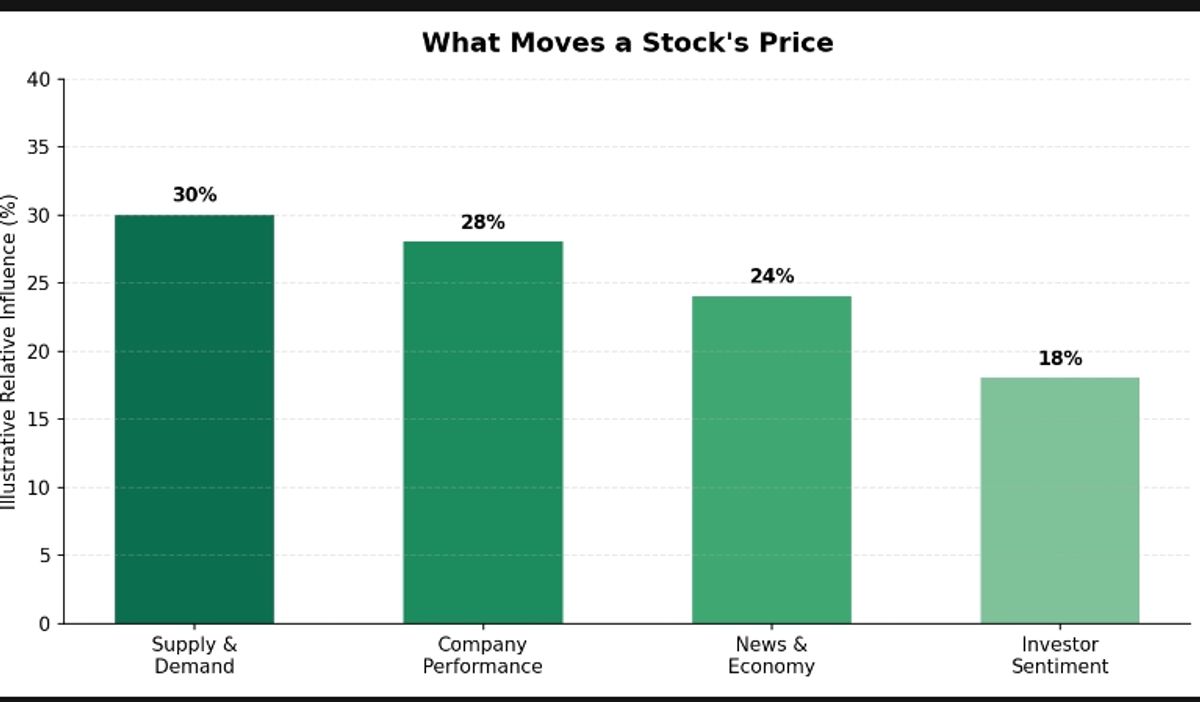
Four forces tend to drive this:
- Supply and demand: more buyers than sellers pushes price up; the reverse pushes it down.
- Company performance: strong revenue, rising profit, and credible management attract investors.
- News and the broader economy: interest rates, currency moves, inflation, government policy, and global events can shift sentiment overnight, often for reasons unrelated to the company itself.
- Investor sentiment: sometimes the market is pricing in expectations about the future, not just today's numbers.
This is exactly why the same fundamentally sound company can rally one month and pull back the next. The Nigerian market has shown this vividly in 2026: the ASI gained roughly 47% in the first half of the year alone, driven heavily by bank recapitalisation and a surge in oil and gas stocks, before cooling into a choppier pattern by August, where the index actually dipped for a few weeks before recovering again into September.
A Real Example: What Actually Happened to Aradel Holdings Investors in 2026
Rather than a made-up scenario, here's what really played out on the NGX this year. On January 2, 2026, Aradel Holdings Plc shares closed at ₦670. If you had put ₦1 million into the stock that day, you'd have owned roughly 1,493 shares.
- By June 30, 2026, the share price had climbed to ₦1,417.50, a gain of about 112% in six months.
- That ₦1 million position would have been worth roughly ₦2.11 million on paper, purely from the share price move, before any dividend.
- The catalyst was largely sector-wide: rising oil prices and strong earnings lifted the entire NGX Oil & Gas Index by over 90% in the same period, so Aradel wasn't moving in isolation, the whole sector was being repriced.
This example cuts both ways, though. A stock that has already doubled in six months carries a different risk profile than it did in January, sharp rallies can just as easily reverse. The lesson isn't “buy what already went up,” it's that concentrated, sector-driven moves like this are exactly why understanding what's happening in an industry, not just a single share price, matters before you invest.
How to Read Basic Company Fundamentals Before You Buy
You don't need an accounting degree to avoid buying blind. A few simple numbers, all publicly available in a company's financial statements or on most trading apps, tell you a lot:
- Price-to-Earnings (P/E) ratio: the share price divided by earnings per share. As an illustration, a bank trading at roughly 5 times earnings is priced cheaply relative to its profit; a much higher multiple means the market is paying up for expected future growth. Comparing a company's P/E to others in its sector tells you whether it looks expensive or cheap relative to peers.
- Dividend yield: the annual dividend as a percentage of the current share price. Several NGX bank stocks have offered yields near 8–9% in 2026, which tells you how much income you'd earn from dividends alone at today's price, separate from any capital gain.
- Earnings per share (EPS) and Return on Equity (ROE): EPS shows how much profit is attributable to each share you own; ROE shows how efficiently a company turns shareholder capital into profit. A consistently rising EPS alongside strong ROE is generally a healthier sign than a rising share price alone.
- Revenue and profit trend over several years, not just one quarter: a single strong quarter can be a one-off; a multi-year upward trend suggests something more durable.
None of these numbers guarantee a good outcome, but checking them takes a few minutes and turns “a friend told me to buy this” into an actual decision you understand.
What's Changed on the NGX Recently (and Why It Matters)
A few structural shifts worth knowing about if you're starting now:
- Extended trading hours. Since April 27, 2026, the NGX now trades from 9:00 a.m. to 4:00 p.m. WAT, nearly double the previous window, giving investors more time to react to news during the day.
- Frontier Market reclassification. FTSE Russell reclassified Nigeria back to Frontier Market status, effective September 2026, a status that had been lost since 2023. This tends to attract more foreign portfolio investment over time.
- A record-setting year. As of September 11, 2026, the ASI stood at roughly 243,000 points, up over 55% for the year, market capitalisation has grown from about ₦106 trillion in January to over ₦157 trillion.
None of this changes the fundamentals of how investing works, but it's useful context: markets move in cycles, and a strong year doesn't guarantee the next one looks the same.
Taxes and Fees Nigerian Investors Should Actually Budget For
This is the part most beginner guides skip, and it genuinely affects your returns. Every NGX trade carries costs beyond the share price itself:
- Brokerage commission: typically 0.5% to 1.5% of the trade value, charged on both the buy and the sell, depending on your broker. This is the one negotiable component, and it's worth comparing across platforms.
- Regulatory and exchange fees: the SEC and NGX each charge a small fixed percentage (commonly around 0.3% each) on every trade, plus a CSCS fee for holding your shares electronically. These are the same no matter which broker you use.
- Stamp duty and VAT: a statutory charge on the transaction, plus VAT applied to the commission portion, not the full trade value.
- Altogether, a full round trip, buying and later selling, can cost somewhere in the region of 2% to 4.5% of your trade value before fees, depending on your broker and trade size. That's not a reason to avoid investing, but it does mean frequent trading eats into returns faster than long-term holding.
- Capital gains tax relief: as of January 2026, individual investors are exempt from capital gains tax on share sales where total proceeds stay below ₦150 million and total gains stay below ₦10 million in any 12-month period, which covers the vast majority of retail investors in Nigeria.
- Dividend withholding tax: Nigeria withholds 10% on dividends at source, and for individuals this is treated as final tax, so there's typically nothing further to pay on that dividend income.
How Can a Beginner Start Investing?
- Learn the basics before putting in money, not after.
- Set a clear goal: are you investing for growth, income, or both?
- Choose a regulated broker or platform, licensed by the SEC in Nigeria.
- Start with an amount you're genuinely comfortable losing.
- Research a company before buying, not after.
- Think long term and keep learning as the market evolves.
Stock Market Terms Beginners Should Know
- Stock/Share: A unit of ownership in a company.
- Investor: Anyone who buys shares expecting a return.
- Broker: A licensed intermediary that executes trades on your behalf.
- Stock exchange: A regulated marketplace where shares are traded, e.g. the NGX.
- Dividend: A portion of company profit paid out to shareholders.
- Capital gain: Profit from selling a share above its purchase price.
- Portfolio: The collection of investments an individual holds.
- Index: A measure that tracks the overall performance of a group of stocks, like the NGX All-Share Index.
- Bull market: A sustained period of rising prices.
- Bear market: A sustained period of falling prices.
Final Thoughts
Owning a stock means owning a small, real stake in a company's fortunes, nothing more mystical than that. Prices rise and fall on a mix of company performance, investor psychology, and events far outside anyone's control, and 2026 has been a strong reminder of just how quickly sentiment on the NGX can shift, from a blistering first half, to a choppier August, to renewed strength heading into September.
If you're just starting out, don't try to time the next big rally. Focus on understanding what you own, invest only what you can afford to lose, and give your investments time to work. That's the approach that's served long-term investors well, on the NGX and everywhere else.